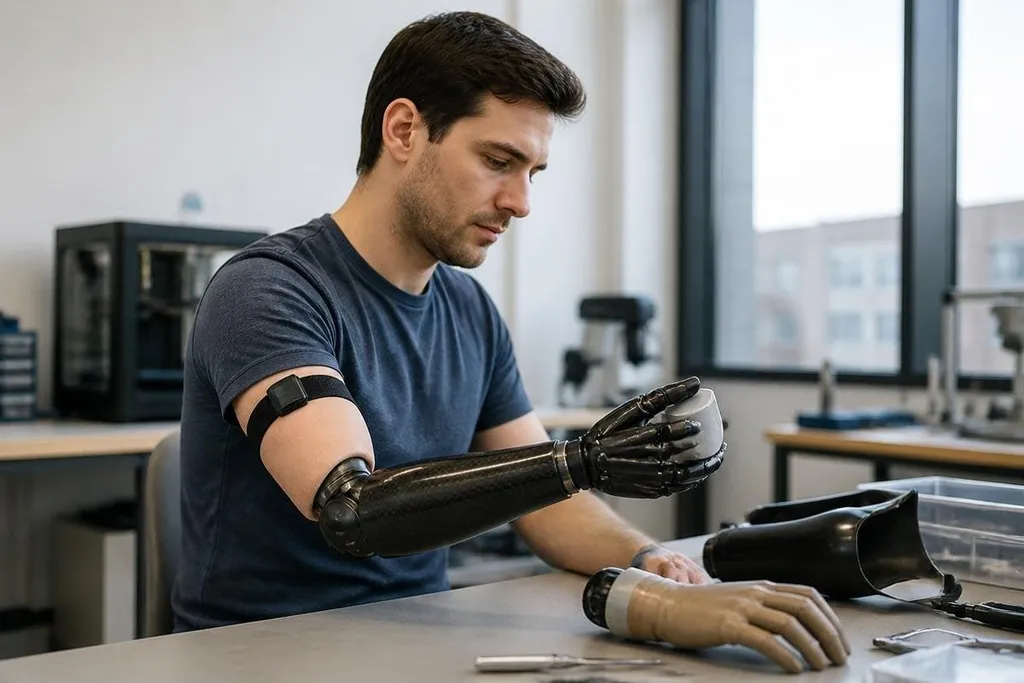
A robotic prosthesis has to do more than move when a motor receives a command. It has to read the user’s intent, react to changing loads, and stay useful through a full day. The advances worth watching are the ones that improve that loop.
- Better control: sensors read muscle signals and movement together.
- More natural feedback: pressure, force, and position can reach the user through sound, vibration, or nerve signals.
- Practical hardware: weight, battery life, repair, and price still decide daily use.
Control that follows the user
Most powered prostheses start with a myoelectric signal. Electrodes placed near a muscle detect small changes in electrical activity, then software maps those changes to an action such as opening a hand or lifting a foot.
That method works best when the signal stays clear. Sweat, socket movement, muscle fatigue, and a change in posture can alter the reading.
The next step is sensor fusion: software combines muscle signals with data from an inertial measurement unit, which tracks motion, and force sensors that measure contact with the ground or an object.
The benefit is practical. A leg prosthesis can use foot pressure to detect a step, then adjust the knee as the user moves from level ground to a stair. A hand can use motor position and grip force to hold a cup without crushing it. Those actions still need testing across many users, body shapes, walking speeds, and daily tasks.
Feedback that reaches the person
Control is only half the problem. A user also needs to know what the prosthesis is touching and where the joint sits without watching it constantly.
Researchers are testing several routes. Small vibration motors can signal pressure levels through the skin. Electrical stimulation can create sensations in nearby nerves. Surgical interfaces may connect electrodes to nerves or muscles, giving software a place to read signals and send them back.
The hard test is useful information, not a single sensation during a lab task. Feedback must stay clear while the person walks, carries an object, or wears several layers of clothing. It also has to remain safe and comfortable over long periods.
A lab result matters less if the device fails during daily movement. Dated prosthetic robotics reporting can place the device, test setting, date, and measured result beside claims about comfort, control, and wear time.
Hardware people can wear
A controller can make a smooth decision, but the motor still has to fit inside a device that someone can wear for hours. That puts limits on weight, heat, noise, battery size, and joint strength.
Powered knees and ankles need enough torque to support the body during stairs and uneven ground. A robotic hand needs several degrees of freedom, meaning several joints that can move under separate control, yet every added motor raises weight and power use.
The socket also deserves attention. It connects the body to the prosthesis, so pressure in the wrong place can cause pain even when the control software works well. A strong demo says little about daily use if the device needs frequent charging or adjustment.
What still needs proof
Many systems can perform a task under controlled conditions. That result does not show how the device will work after months of wear, repairs, sweat, impact, and changing user habits.
The evidence to watch should include long-term use, repeatable walking or grasp tests, battery data, repair records, and the price of care after purchase. A device that works for ten minutes in a lab may still fail the person who needs it for a commute or a work shift.
I'd judge a prosthetic robot by the number of tasks it handles without demanding constant attention from its user.
A practical buying and research checklist
Use these questions when you compare a new prosthetic system, trial, or research claim:
- Check the user group. Confirm whether the test involved people with the same amputation level and daily needs.
- Read the task details. Look for walking, stairs, slopes, grasping, or object handling rather than a single staged action.
- Ask about feedback. Find out which signals the user receives and how the system works when sensors lose contact.
- Count the support needs. Record charging time, socket changes, software updates, servicing, and training.
- Separate access from price. Include clinical fitting, replacement parts, and follow-up care in the cost.
The next useful proof will come from longer trials that measure comfort, repairs, battery use, and missed actions beside movement quality. Until those results are common, the best prosthetic robot is the one that reduces work for the person wearing it, task by task.